Creative Health Institute
About us
mission : To continue on the works of our founder, Dr. Ann Wigmore, in a manner that she would be proud of.
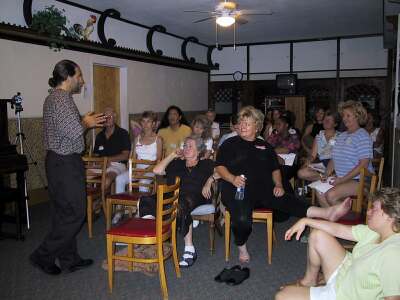
Creative Health Institute, often called "The Wheatgrass Place", is a natural health learning center which provides a natural program of body purification, nutrition and rejuvenation through the use of fresh raw fruits, vegetables, juices, nuts, sprouted seeds, grains, beans, chlorophyll rich greens and wheatgrass juice. The total health solution.
At Creative Health Institute we teach the raw living foods philosophy as originated by the late Dr. Ann Wigmore, who taught here for many years. Students come here to experience the natural health transforming benefits of wheatgrass and other living foods while learning how to integrate these into their own lifestyles.
Our cirriculum revolves around learning by doing - a hands-on approach that emphasizes "experience is the best teacher." We sell neither supplements nor remedies, we simply teach.
Through direct involvement, loving guidance and sharing, our students have an opportunity to develop self-responsibility for their personal health and wellness.
- founded in 1976 by Donald O. Haughey
- vegetarian dietsan IRS approved 501(c)-3 non-profit trust
- vegan dietslocated outside of Union City, MI, on the banks of the Coyote River
- Hippocrates Institute of the Midwestover 10,000 program graduates
- thousands of healing successes
- motivated by the spirit of helping others
- numerous classes every day, and lots of hands-on training
- a teaching and learning facility, not a spa
People come here for many reasons. Some are vegetarians seeking to learn appetizing ways to prepare food. Others seek the natural health and energy benefits of the raw living foods lifestyle, especially if they've read books like "Raw Family." Some of our visitors arrive with a variety of cancers and other illnesses and are looking for the miracle of wheatgrass. And many are seeking a simple, enjoyable way to lose the many pounds they've gained through years of indulgent living.
The article, "Collapse of Our Health Care System; Rising Costs, Decreasing Quality, Missing Doctors" in AARP Bulletin, March 2003, put us on notice that we need to become personally involved with our health care, and that there are valid alternatives to modern (alopathic) medicine. Doctors are now re-learning that we can't just take a pill and undo years of abusing our bodies. Instead, we need to learn what proper diet and nutrition really are, and practice them.
Failing pension plans, the bankruptcy of the Social Security Program, and waning hospitization coverage benefits all warn us that we better be prepared to fund our own health care in the coming years. Since an ounce of prevention is worth a pound of cure, we're well advised to learn to stay healthy and not get sick in the first place.
Dr. Lorraine Day, MD, states in her video, "Sorting Through the MAZE of Alternative Medicine," that the Wigmore Program cured her cancer.
Whether you seek to remain healthy or to regain your health, we're ready to teach you the benefits of the raw living foods and wheatgrass natural lifestyle.
"Vegetarians have a 40 percent less risk of cancer and much less risk of heart disease, diabetes, hypertension, kidney disease, and other problems that are common among meat eaters... Vegetarians also live several years longer and enjoy better health." -- Neal Barnard, president of the Physicians' Committee for Responsible Medicine, 2001.
"... illness and degeneration of health can be attributed to malnutrition and congestion." -- Dr. Ann Wigmore, ND, DD
Living Foods

Through years of research Dr. Ann Wigmorediscovered that all the enzymes, vitamins and minerals that the body needs are found within the foods we eat -- IF these foods are prepared in such a way as to maintain or unlock their life-giving nutrients.
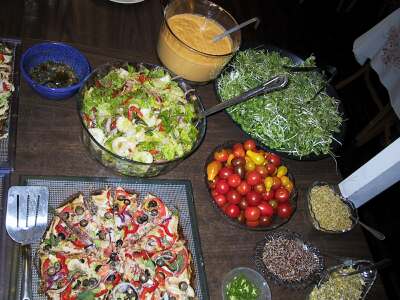
The living foods that we serve and teach you how to prepare are high-enzyme, chlorophyll-rich and easy to digest so that your body can receive optimal nourishment. Meals consist of live foods such as young organic greens, sprouted nuts, seeds and grains, fruits and vegetables, lightly fermented preparations, and dehydrated crackers and snacks.
If planted, all living foods would sprout and grow.
Wheatgrass juice is used by students throughout the day because of its usefulness in aiding the body to clean and rebuild itself. Wheat grass contains all vitamins necessary for the normal function of the human body such as riboflavin, vitamin C, B complex, and all of the 100 elements which the balanced earth contains.
Creative Health Institute has educated thousands of people in this program over the years. In just two weeks participants learn, practice, and feel the results of the Living Foods Lifestyle that rejuvenates the body and prevents disease.
- raw Our programs are hands-on, a great experience for the whole family.
- natural Experience how easy living food preparation really is.
- wigmore Learn how to clean waste out the body's systems while feeding it with highly nourishing, vital and easily digested foods.
- vegan Achieve the means of healthy, natural living that gives a whole new outlook on eating and well-being.
- vegetarian Extensive classroom and kitchen instruction, with both video and live instructors.
Wheatgrass
When desperate patients and family members call our office hoping for miracles we always tell them we are out of magic bullets. Just as the development of cancer is a complicated process, so too, complete and permanent recovery from cancer requires a slow repair process in which careful attention must be paid to multiple aspects of body chemistry.
One gift of nature - chlorophyll - more closely approximates a miracle food than any other we've encountered.
Wheat grass juice is an excellent source of chlorophyll. Wheat grass juice is also high in iron, oxygen, and enzymes and is one of the richest sources of vitamins A, B, and C.
Studies of wheatgrass by Dr. Chiu Nan Lai of the University of Texas System Cancer Center showed it to be a potent inhibitor of several carcinogens. Applying low levels of the extract to mutagens diminished activity in them by up to 99%.
More research has examined the healing properties of chlorophyll in general and seems to be related to the fact that the chlorophyll molecule is nearly identical to that of hemoglobin, whose single atom of iron replaces one atom of magnesium.
Distinguished medical specialists have reported hundreds of cases in which chlorophyll has cured deep infections, stimulated healing, removed necrotic debris from open wounds, and accelerated connective tissue and epidermal proliferation.
Many reports of chlorophyll's effectiveness have come through Dr. Ann Wigmore, ND, and teacher of natural living. Dr. Ann credits wheatgrass with curing her gangrenous leg and preventing its amputation. She subsequently founded the Hippocrates Health Institute in Boston to teach others about wheatgrass.
According to Dr. Ann, Dr. Bernard Jensen and G. P. Earp-Thomas of Bloomfield Laboratories, chlorophyll purifies the blood, prevents tooth decay, aids in proper digestion, helps detoxify the liver, keeps the thyroid gland in balance, cleanses internal organs, enhances capillary function, supports sex hormones, decontaminates inorganic chemicals, and builds up white blood cell counts.
Furthermore, green juices provide easy assimilation of nutrients especially in cases of poor digestion or immuno-suppression. Reports of chlorophyll's effectiveness in managing human ailments abound.
Recent medical research has found that cancer goes into remission when the body is alkaline. The raw living foods diet helps to make the body alkaline (easily tested with litmus paper), but our personal experiences since 1976 support the research of Dr. Wigmore -- wheatgrass juice is an important part of the diet and program.